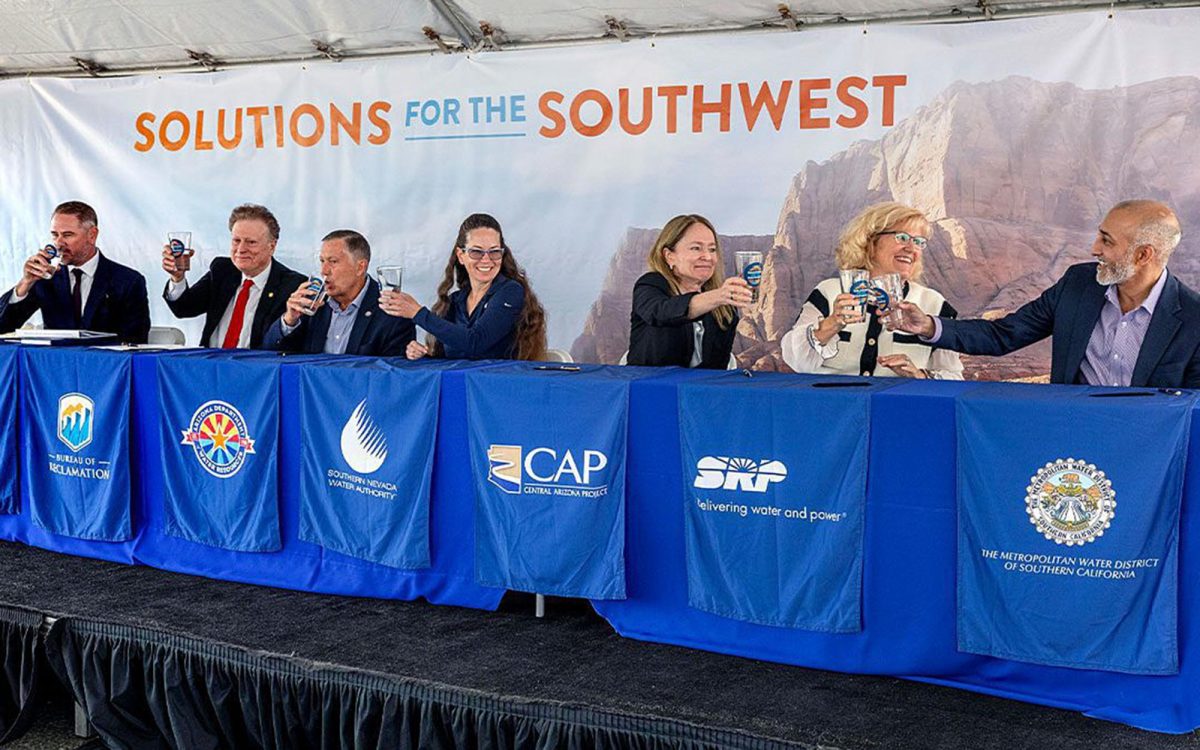
Water leaders from California, Nevada and Arizona gathered at the Claude “Bud” Lewis Carlsbad Desalination Plant on Wednesday, June 3, to sign an agreement aimed at exploring interstate water exchanges as a way to strengthen long-term water reliability across the Southwest.
The memorandum of understanding was signed June 3 at the plant by officials from the San Diego County Water Authority, U.S. Bureau of Reclamation, Metropolitan Water District of Southern California, Southern Nevada Water Authority, Arizona Department of Water Resources, Central Arizona Project and Salt River Project.
Under the agreement, the agencies will examine legal, policy and operational frameworks that could allow future exchanges involving desalinated seawater, recycled water and other new water supplies across state lines. The discussions are intended to identify ways agencies could share investments in water projects and use existing infrastructure to improve regional water reliability without changing existing water rights or reallocating Colorado River supplies.
The agreement is nonbinding and does not commit any of the participating agencies to specific projects, according to a San Diego County Water Authority news release. Instead, it establishes a process for evaluating whether pilot exchanges could serve as a model for future interstate partnerships.
Officials said the effort comes as prolonged drought and declining reservoir levels continue to strain the Colorado River system, which serves more than 43 million people across the Southwest. The agencies said interstate exchanges could provide additional flexibility by allowing water users to collaborate on projects such as desalination and water recycling while sharing costs and benefits.
“Next-generation strategies in the face of climate volatility must include interstate partnerships that deliver water where it’s needed most,” Dan Denham, general manager of the San Diego County Water Authority, said in the news release. “New ideas are challenging to implement, but it’s in everyone’s best interest to make this work.”
The agencies said the discussions could help shape future Colorado River management strategies as federal officials develop new operating guidelines for the river system.
This report was partially written using artificial intelligence, then updated, edited and fact-checked against source material by North Coast Current staff. View our AI policy on the About Us page.