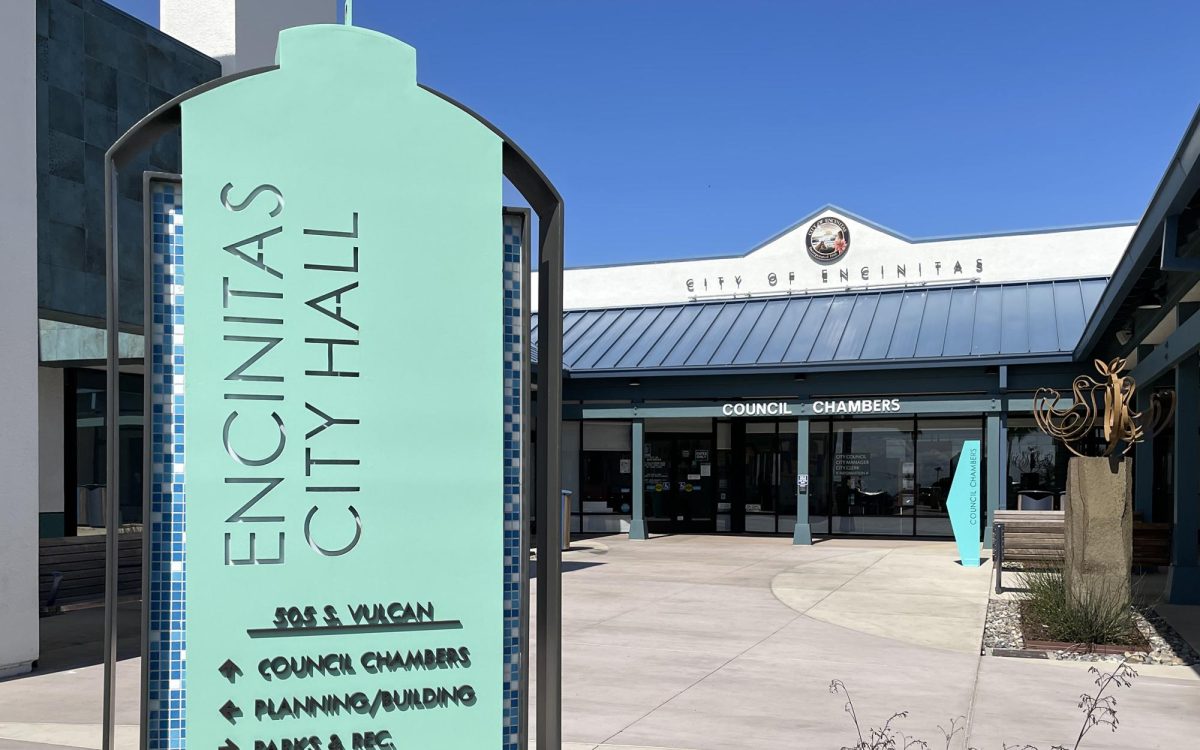
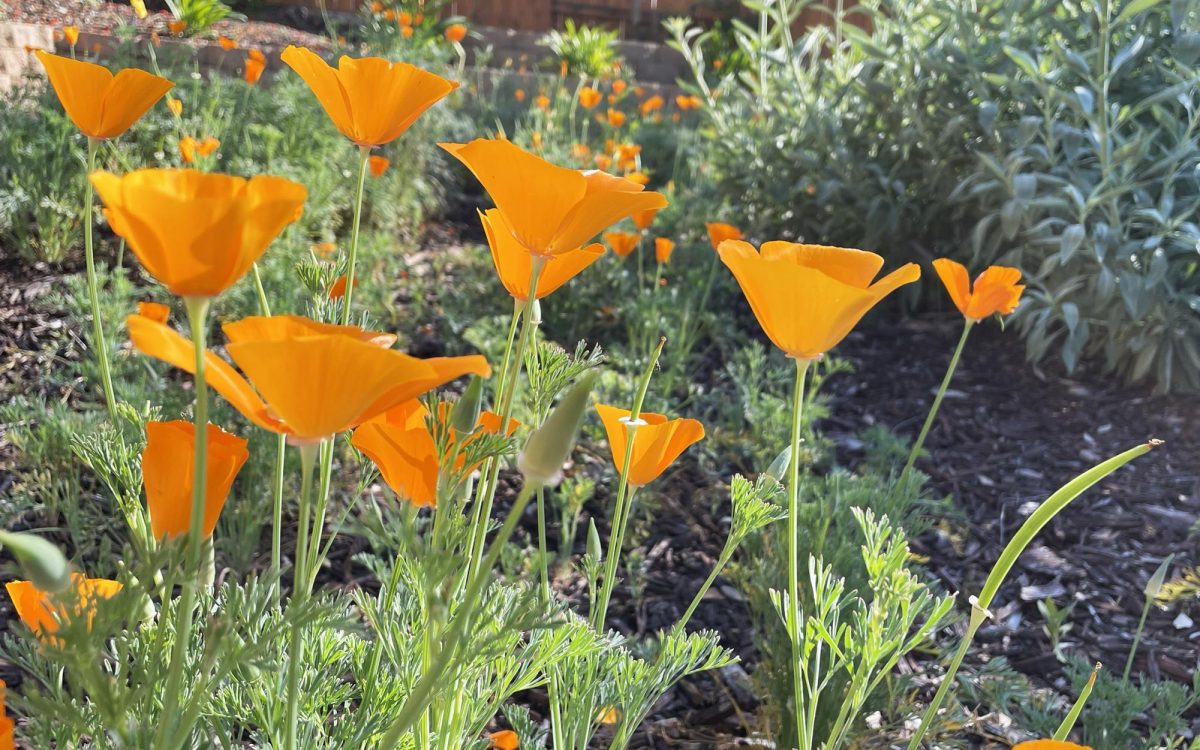
Nearly five years of community and expert input led to the advancement of an Encinitas city native plant policy Wednesday, March 25, the first formal code of its kind in San Diego County.
The Encinitas City Council unanimously approved the new Native Plant Ordinance with an intention to revisit and revise the policy in the future, council members noted in discussions after a presentation by city staff members and comments from residents.
The proposal represents the culmination of several years of planning, public workshops and commission review. The Planning Commission recommended approval in February.
“All the other cities in the region are looking at Encinitas now to understand how they can do something similar,” Don Rideout, representing Native Plants 4 Encinitas, said in public comments ahead of the council’s vote. “This is something where Encinitas really has a chance to lead, and I urge you to take advantage of that opportunity.”
Rideout said that other communities in the county are considering similar actions to encourage the increased use of native plants in landscaping and habitat preservation.
In 2022, San Diego County launched the development of its Native Landscape Program for unincorporated areas of the region.
At its core, the Encinitas ordinance aims to reshape how landscaping is approached in the city by prioritizing plants native to Southern California ecosystems. Supporting pollinator populations, improving biodiversity and creating landscapes better adapted to local climate conditions are among the policy’s goals.
The ordinance establishes new landscaping standards tied to existing discretionary permits, including design review approvals, major use permits in open space zones and city-led projects. Single-family homes, including accessory dwelling units, are exempt, reflecting earlier public input and policy direction from city leaders.
Under the proposed rules, at least 50% of a qualifying project’s landscaped area must consist of native plants, with separate calculations for trees and other vegetation. Stricter requirements apply near sensitive areas: landscaping within 50 feet of environmentally sensitive habitat or open space must be entirely native, and all qualifying city projects must use 100% native plants.
Rather than developing its own plant list, the city will rely on Calscape, a database maintained by the California Native Plant Society, to guide plant selection based on local ecological conditions.
The ordinance also includes procedural requirements such as the submission of plans prepared by licensed landscape architects and a final certification confirming that installation complies with approved designs. City officials opted not to impose detailed maintenance standards, instead relying on professional best practices while retaining the ability to enforce compliance.
The use of licensed landscape architects drew criticism from a resident who filed an anonymous complaint with the state Fair Political Practices Commission over a potential conflict of interest with Councilmember Joy Lyndes, who ran an architectural landscape firm in Encinitas before joining the City Council.
Ahead of the council’s vote, Lyndes said that she filed a response with the FPPC but had not yet received a reply by the time of Wednesday’s meeting, although she said the FPPC was aware that the ordinance was on the meeting agenda. In her response on the dais, Lyndes said that she had no benefit from the Native Plant Ordinance since she no longer practiced in the profession.
“They’re aware that this item is on our agenda tonight,” Lyndes told the council. “So I’m making a statement that I do not have a conflict of interest and will proceed with my involvement with this action.”
Lyndes said the anonymous claim also took issue with the ordinance because its provisions created a perceived benefit to the profession by increasing its body of work, which she stated would not be the case given how the ordinance would be applied related to already existing policies.
Lyndes and Mayor Bruce Ehlers both talked about their interest in developing an ordinance of some kind, noting the efforts of residents and local groups over the past few years to build a framework.
Alongside the regulatory changes, city staff members outlined potential incentive programs as part of the ordinance — such as rebates, workshops and free plant offerings — aimed at encouraging voluntary adoption among residents not subject to the ordinance.
Village Park resident Basey Klopp, also a member of Native Plants 4 Encinitas who serves as a parent adviser to San Diegutio High School Academy’s student Garden Club, told the council during public comments that the ordinance puts the city in a leadership role of a growing movement.
“With council’s approval tonight, Encinitas would be at the forefront of a small but rapidly growing movement to restore native plants to our country’s landscape,” Klopp said. “We are lucky enough to live in the most biologically rich county in the continental United States, but it is also the most threatened, with around 200 imperiled plants and animals, more than any other county in the country.”
Comments submitted ahead of the council’s meeting reflected a divide between environmental priorities and concerns about impacts to fire-prone areas such as Olivenhain.
Camille Perkins, an Olivenhain resident, asked the city to reconsider how the ordinance would apply in high fire hazard zones, warning it could limit vegetation management and increase wildfire risk.
“I remain convinced that the draft Native Plants Ordinance does not practically work in the Rural Residential areas designated as High/Very High Fire Hazard Severity,” Perkins wrote, adding that it could “create a more dangerous environment with less ability for fuel abatement moving forward.”
Perkins and others argued that expanding native habitat near homes could trigger environmental protections that restrict vegetation removal, complicating fire prevention efforts and potentially increasing long-term risks.
In response to those concerns, Ehlers said during the meeting that the policy does not override fire codes such as fire safety zones and requirements for risk management. He said having a formal ordinance rather than a voluntary program can help in that regard.
“Why is this an ordinance?” he said during the meeting. “One of the reasons is to put it on the proper footing and in the proper relation to our fire code.”
John Helmer, chair of the Nature Collective, which oversees the San Elijo Lagoon Ecological Reserve, also spoke to those concerns during in-person public comments.
“We recognize the significant community concern about fire hazards, particularly in high-risk zones such as Olivenhain. Our organization maintains a neutral position on debate surrounding fire management. However, we’d like to emphasize that native landscaping and fire safety are not mutually exclusive,” Helmer said in reading a letter from Nature Collective Executive Director Jennifer Bright. “Many low-fuel, drought-tolerant native species are excellent candidates for fire-wise defensible space. We support the continued authority of the Fire Department to oversee vegetation abatement and ensure that public safety remains the primary filter through which landscaping choices are made.”
Other residents during public comments questioned whether there needed to be a formal ordinance as opposed to a voluntary program with an educational component, mostly surrounding costs to businesses and residents for future landscaping projects.
“I think a native plant policy is a good idea, but I’m not sure it should be a law the way you have it framed,” Cardiff resident and past mayoral candidate Julie Thunder told the council.
Thunder and others also asked the council to consider a plan that more closely reflects the support of native species closer to home as opposed to a broader allowance of regional Southern California plants, “because as it stands, it’s not about Encinitas natives,” Thunder said.
Ehlers, in a light moment where he said he was a “native plant nerd,” noted the irony that the plants most native to coastal North San Diego County aren’t easily available to plant.
“I would love to be able to do hyperlocal. Trouble is, you can’t buy them,” Ehlers said. “I would love to buy Encinitas baccharis and put it in my yard. I would love to buy local Del Mar manzanita, federally endangered hyperlocal plant. You can’t get it.”
Ehlers and some of the residents who spoke also said that efforts such as Encinitas’ can help build greater awareness of plant species unique to coastal North County.
“Development, invasive species and habitat fragmentation are real challenges for the plants and animals that we have unwittingly displaced,” speaker Basey Klopp said. “This ordinance gives Encinitas an incredible opportunity to help local flora and fauna going forward. Native plants are not only beautiful, they are the foundation of all native wildlife.”
The ordinance is set to take effect 30 days after approval.